Beginner label guide
How to Read a Focus Supplement Label
A focus supplement label should help you slow the decision down. Before you think about whether a product sounds powerful, check what is actually in it, how much is listed per serving, what is hidden inside blends, and whether the warnings fit your situation.
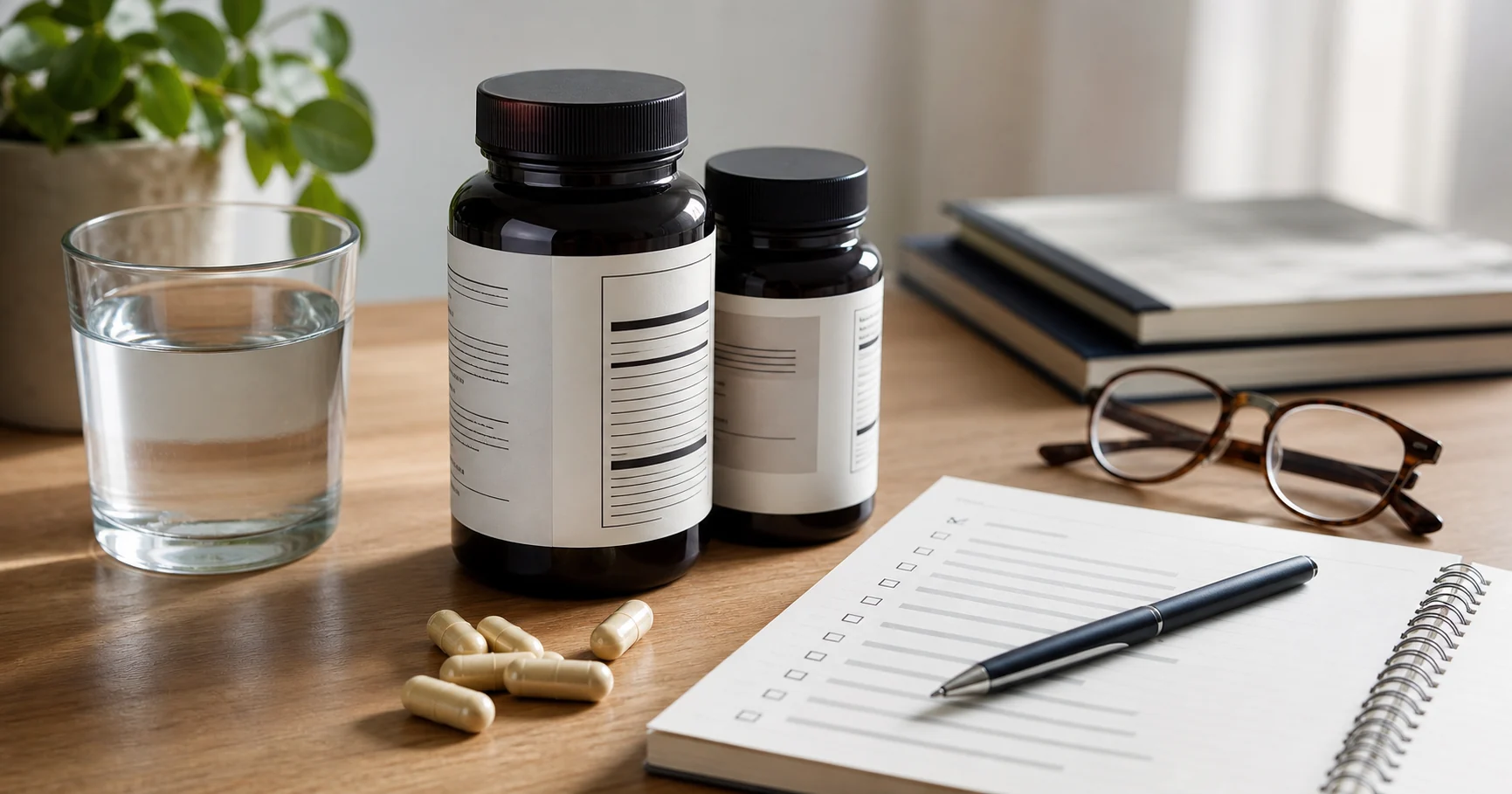
This guide is non-commercial. It does not recommend products or affiliate links. Use it as a practical checklist before comparing ingredients or asking a qualified clinician or pharmacist about a supplement.
Label-reading benefits
Know what is active
Separate the ingredients that drive the focus claim from fillers, flavors, and marketing language.
Compare real servings
Check serving size, servings per container, and listed amounts before comparing products.
Spot hidden stimulation
Look for caffeine, guarana, blends, repeat-serving language, and warnings that affect fit.
Start with the Supplement Facts panel
The Supplement Facts panel is the main place to check serving size, servings per container, dietary ingredients, and the amount per serving when an amount is declared. Do this before reading marketing claims on the front of the bottle.
Check these first
- Serving size: one capsule, two capsules, one scoop, or another amount.
- Servings per container: how long the container actually lasts.
- Amount per serving: whether each active ingredient is clearly listed.
- Daily Value: whether a nutrient has a listed percent Daily Value.
- Other ingredients: fillers, binders, flavors, sweeteners, colors, or capsule materials.
Serving size can change the whole label
Many labels look simple until you notice the serving size. If a product lists amounts per two capsules, taking one capsule is not the same label amount. If a powder uses a scoop, the scoop size matters.
Do not compare products by front-label claims alone. Compare the actual amount per serving, the number of servings, and whether the label is clear enough for you to understand what you would be taking.
Find the active ingredients
Active ingredients are the ingredients most likely to drive the product's focus-support positioning. In focus supplements, these may include caffeine, L-Theanine, choline-related ingredients, creatine, amino acids, herbs, vitamins, minerals, or other dietary ingredients.
Beginner questions
- Can you identify every ingredient that is meant to do something?
- Is the amount for each ingredient listed, or is it hidden in a blend?
- Are there several ingredients with similar stimulant-like positioning?
- Does the label separate dietary ingredients from other ingredients?
- Do any ingredients raise medication, pregnancy, breastfeeding, or medical-condition questions?
Be careful with proprietary blends
A proprietary blend may list several ingredients under one combined amount. That can make it harder to know how much of each individual ingredient is included.
A blend is not automatically bad, but it lowers transparency. For a beginner, a label that clearly lists individual ingredient amounts is usually easier to evaluate than a label built around a dramatic blend name.
Blend red flags
- A large blend name with many ingredients and only one total amount.
- Caffeine or stimulant-like ingredients hidden inside the blend.
- Front-label claims that sound stronger than the details in the panel.
- No clear way to compare the ingredient amounts with other labels.
Watch caffeine and stimulant stacking
For many focus products, caffeine is the most important label detail. Check whether caffeine is listed directly, appears through botanical sources, or is part of a blend. Also consider caffeine you already get from coffee, tea, energy drinks, pre-workout products, or medications.
More stimulation is not automatically better focus. If you are sensitive to caffeine, have sleep disruption, feel jittery, or notice crashes, a higher-stimulation label may be a poor fit even if the marketing sounds productivity-focused.
Look for stacking clues
- Caffeine, guarana, yerba mate, green tea extract, or coffee fruit extract.
- Multiple products used on the same day that each contain caffeine.
- Instructions that encourage repeat servings without a clear total-caffeine context.
- Warnings about caffeine sensitivity, sleep, heart, or blood-pressure concerns.
Understand choline ingredients
Choline-related ingredients, such as citicoline or Alpha GPC, are often positioned for focus or cognitive support. Treat them as a more specialized category, not a default beginner starting point.
Read the exact ingredient name. "Choline" on the front of a label may not tell you which form is used, how much is included, or whether it is part of a wider blend.
Choline label questions
- Which form is listed: citicoline, Alpha GPC, choline bitartrate, or another form?
- Is the amount listed individually?
- Is it paired with caffeine or other stimulating ingredients?
- Does the product make broad memory or brain-performance promises that need scrutiny?
Read herbs with extra caution
Herbs and botanicals can be harder for beginners to compare because the label may include plant part, extract type, standardization details, or a proprietary blend. A natural-sounding ingredient is not automatically safer or better suited to you.
If medication use, pregnancy, breastfeeding, a medical condition, surgery, or strong sensitivity is part of your situation, ask a qualified clinician or pharmacist before using herbal focus products.
Herb label questions
- Does the label name the plant part, such as root, leaf, or extract?
- Does it state an extract ratio or standardization detail?
- Is the herb combined with caffeine or other stimulant-like ingredients?
- Are the warnings specific enough for your situation?
Third-party testing is useful, but not magic
Third-party testing can be a positive signal when it is specific and verifiable. It may relate to identity, purity, contaminants, banned substances, or manufacturing quality, depending on the program and the claim.
A vague quality badge is weaker than a named certification, lot-specific testing, or a clear explanation of what was tested. Testing does not prove that a supplement will work for you or that it is appropriate for every health situation.
Testing questions
- Is the testing organization named?
- Does the label or website explain what was tested?
- Is the claim current and tied to this product, not just the brand?
- Does the company provide a lot-specific certificate of analysis?
Do not skip warning labels
Warnings are not just legal text. They can flag situations where a product may be a poor fit, such as medication use, pregnancy or breastfeeding, medical conditions, stimulant sensitivity, sleep issues, upcoming surgery, or use by children.
If the warning section applies to you, do not treat the rest of the label as enough information. Pause and ask a qualified clinician or pharmacist before using the product.
Red-flag claims
- Claims that a supplement treats, cures, prevents, or diagnoses a disease.
- Guaranteed focus, memory, mood, productivity, or performance results.
- "Clinically proven" language without a clear, relevant source.
- Before-and-after promises that make the product sound like a shortcut.
- Claims that make poor sleep, high stress, or persistent symptoms sound simple to solve.
- Pressure tactics such as extreme scarcity, miracle language, or hidden ingredient details.
A simple label-reading checklist
Read the Supplement Facts panel before the front-label claims.
Confirm serving size and servings per container.
Identify every active ingredient and the amount per serving.
Look for proprietary blends and unclear amounts.
Check caffeine and other stimulant-like ingredients, including your other daily sources.
Review choline forms, herbs, warnings, and third-party testing claims.
Reject products that lean on disease claims, guaranteed results, or hidden formula details.
Ask a qualified professional if medication, pregnancy, breastfeeding, a medical condition, or persistent symptoms are involved.
Evidence and sources
This guide uses supplement-label and dietary-supplement regulatory sources to keep label-reading advice practical and cautious.
Source checked
Sources
Sources are included so readers can check the basis for our wording. We use sources to keep claims specific and cautious; sources do not mean an ingredient or product will have predictable results.
See Editorial Standards and Methodology for how sources are used.
- Safety / regulatory guidance
Explains how dietary supplements are regulated, required label basics, and why consumers should discuss supplement use with a health care professional.
- Safety / regulatory guidance
Dietary Supplement Labeling Guide: Chapter IV. Nutrition Labeling
FDA labeling guidance for Supplement Facts panels, serving size, servings per container, ingredient declaration, and proprietary blends.
- Safety / regulatory guidance
Dietary Supplement Labeling Guide: Chapter V. Ingredient Labeling
FDA guidance on ingredient statements, source ingredients, and other ingredients such as fillers, binders, flavors, and sweeteners.
- Safety / regulatory guidance
Background Information: Dietary Supplements
Consumer background on dietary supplements, regulation, labels, safety, and quality considerations.
Editorial process
Discernwell is written by Craig A. and source-checked against published research, supplement labels, and safety guidance where available. We do not claim medical review unless a qualified reviewer is named on the page.
Read the Editorial Standards and Methodology for more detail.